WInsights
  • UHNW Event Calendar 2026

  • Contact

  1. Home
  2. WInsights
  3. Explainers

India’s GDP Grew 7.8%. What the Headline Number Doesn’t Tell You

Riddhiman Jain

|

01 September 2026

Market Commentary

Wealth Management

India's economy grew 7.8% in the April–June quarter, its best start to a year since FY24. The strength is real. But inflation has quietly returned inside that number, which changes what we expect the Reserve Bank to do next.

8.2% Growth measured from the production side, vs 7.0% a year ago11.9% Growth in business investment, roughly double last year12% Export growth, twice last year's pace18.3% Bank loan growth, mid-August

Key figures:

7.8% - Growth after stripping out price rises (6.9% a year ago)
10.3% - Growth in plain money terms (8.1% a year ago)

The difference between the two is inflation. It has widened to 2.5 percentage points from 1.2 a year ago. That is the single most important change in this release.

For two years, growth came without inflation. That has changed.

Through FY25 and FY26, India grew while prices stayed flat. Falling food and commodity prices meant almost all the growth was genuine extra output, which is a comfortable position, because it let the central bank support growth without worrying about inflation.

This quarter broke the pattern. Prices across the economy rose 2.3% against 1.1% a year ago. Farm prices went from flat to up 3.8%, industrial prices from slightly falling to up 3.9%. With output growing at 7.8%, the argument for keeping interest rates low weakens quickly.

Growth in money terms, growth after inflation, and the gap between them. Source: MoSPI, SBI Research, 31 August 2026.

Finance and real estate did the heavy lifting

Services grew 10%, led by finance, real estate and professional services at 12.1% (the fastest of any part of the economy). Manufacturing grew 9.2% and power generation rebounded sharply. Construction held up at 7.7%.

The two soft spots remained Farm output (slowed to 3.6%) which matters for rural demand. Mining shrank 2.4%, the only sector to contract.

Growth by sector, this quarter against the same quarter last year (%). Source: NSO, SBI Research.

Related content

17 August 2026

When the Central Bank Turns Money Away

Inside the numbers behind India's opposite-of-2013 moment

Explainer

Market Commentary

Financial advice as unique as you

Financial advice as unique as you

Companies are spending on capacity again

The most encouraging number in the release is investment. Spending on new factories, equipment and infrastructure grew 11.9%, against 5.8% a year ago. Household spending held steady at 7.1% and exports grew 12%.

One caution. Restrictions on gold imports, brought in after the West Asia conflict escalated in February, have distorted the import and gold figures, as both fell in volume while rising sharply in value. Since imports are subtracted when calculating GDP, an understated import figure flatters the growth number. Our read is that genuine demand grew closer to 7% than 7.8% (still strong).

Where the spending came from, after inflation (%). Gold and import figures are distorted by import restrictions. Source: MoSPI, SBI Research.

Factories are making more and earning less on each unit

Manufacturers produced 9.2% more this quarter. But the prices they charged actually fell 1.4%, having risen 1.8% a year ago. Their costs, meanwhile, went up, due to higher crude oil feeds into fuel, plastics, chemicals and packaging. When costs rise and selling prices fall, margins compress.

This is a profitability signal, not a demand signal. Volumes are fine. It argues for owning businesses that can pass on cost increases (those with pricing power, contracted revenues or regulated tariffs) rather than manufacturing broadly. Some sectors have already begun raising prices: handsets, consumer goods and metals.

Change in selling prices by sector (%). Manufacturing is the only sector where prices fell. Source: MoSPI, SBI Research.

Banks are lending faster than money is coming in

Bank loans grew 18.3% in mid-August against 10.2% a year earlier. Deposits grew 14.7%. That 3.6 percentage point gap is the important part: banks funding loan growth need deposits, and they compete for them by raising rates. Deposit rates can rise before the RBI moves at all.

The two parts of the loan book worth watching are: i) Lending to non-bank finance companies grew 35.7% after shrinking last year, and ii) loans against gold jewellery made up Rs 909 bn of the Rs 2,436 bn of new personal loans between April and July (37% of the total, up 88% on last year). A loan book that concentrated in one commodity, at a time when gold import policy is being actively changed, needs monitoring.

Bank lending growth by borrower type (%). Source: RBI, SBI Research.

Why now a rate increase rather is more probable

Government borrowing gives no relief either. The Budget planned a deficit of Rs 16.96 lakh crore, 4.5% of the economy; after the West Asia crisis, SBI Research estimates Rs 17.35 lakh crore, or 4.6%. Though it is a small slip, but it means borrowing will not fall, hence, longer-dated bonds get no support from that direction.

Putting the pieces together: growth at 7.8% no longer needs help, prices are rising, loan growth is running at 18%, and borrowing stays high. SBI Research's conclusion, and ours, is that the RBI's next move is more likely a modest rate increase, brought forward rather than delayed. Growth is forecast to ease to 7.3%, 7.2% and 6.9% over the next three quarters. This should be seen as a high starting point working through and not a slowdown, which is exactly when a central bank feels able to raise rates.

Growth path for the rest of FY27: first quarter actual, remainder forecast (%). Source: SBI Research.

New lending, April–July 2026 Rs bnGrowth %
Industry2,16520.0
Personal loans2,43616.2
   of which, loans against gold90988.1
Services1,35522.9
   of which, finance companies57835.7
Agriculture62417.0
Total bank credit7,16719.3

Three things we are watching

  1. Manufacturing prices next quarter.
    A second quarter of falling prices would confirm a lasting margin problem rather than a temporary oil-cost lag and would change which sectors we own.
  2. The gap between loans and deposits.
    If it stays this wide, deposit rates rise on their own and bank profitability tightens even in a strong economy.
  3. Gold import policy.
    Any easing would change both the growth arithmetic and the risk in gold-backed lending at the same time.


MORE INSIGHTS

A futuristic robotic hand interacting with digital financial charts.

UHNI

Family Office

AI

Wealth Management

AI in Wealth Management: Uses, Risks & Human Judgement

Explore how AI is transforming wealth management, from investment research to portfolio reporting, and why human judgement and data privacy remain essential.

Article •25 October 2026
A wind turbine partially obscured by mist

UHNI

Family Office

Philanthropy

Impact Investing

Wealth Management

ESG and Impact Investing Among Indian Family Offices

Understanding ESG and Impact Investing and how family offices approach them.

Explainer •22 October 2026
Applying for an IPO in HNI Category: Process and Key Rules

HNI

Wealth Management

Applying for an IPO in HNI Category: Process and Key Rules

Applying for an IPO in the HNI category goes beyond placing a bid. This guide explains the NII framework, S-HNI vs B-HNI, and the step-by-step application process.

Explainer •21 October 2026
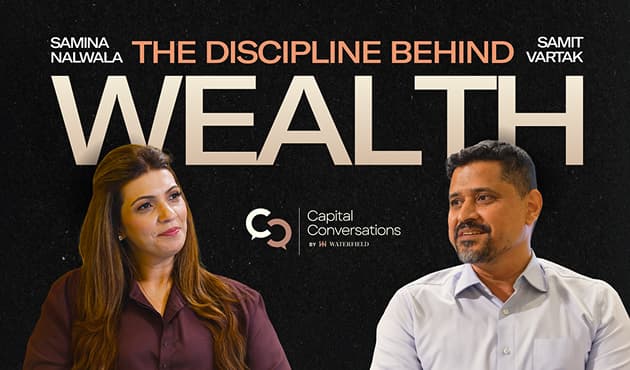
Samina Nalwala and Samit Vartak with the headline “The Discipline Behind Wealth” for Capital Conversations.

Market Commentary

Wealth Management

Capital Conversations | Investing Masterclass ft. Samit Vartak

Samit Vartak shares lessons on small- and mid-cap investing, spotting multibaggers and managing risk.

Podcast •13 October 2026
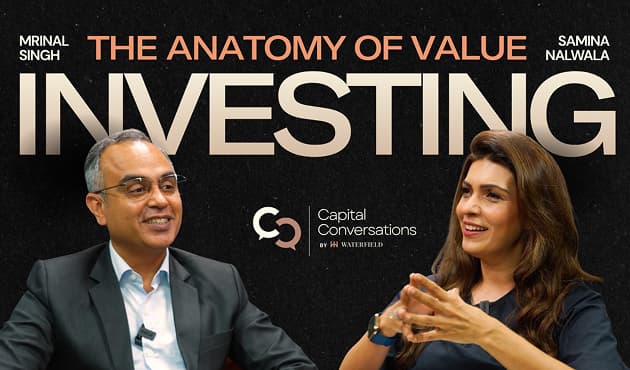
Mrinal Singh and Samina Nalwala with the headline “The Anatomy of Value Investing” for Capital Conversations.

Market Commentary

Wealth Management

Capital Conversations | Value Investing ft. Mrinal Singh

Mrinal Singh explores value vs growth investing, assessing management and building long-term wealth.

Podcast •10 September 2026
A person reviewing reports while using a calculator to analyse data.

HNI

Professionals

Wealth Management

ESOP Proceeds After IPO: A Guide to Managing the Windfall

An IPO turns vested ESOPs into taxable, liquid wealth. This blog covers the tax rules, a step-by-step plan, and mistakes to avoid with the proceeds.

Explainer •28 October 2026
A futuristic robotic hand interacting with digital financial charts.

UHNI

Family Office

AI

Wealth Management

AI in Wealth Management: Uses, Risks & Human Judgement

Explore how AI is transforming wealth management, from investment research to portfolio reporting, and why human judgement and data privacy remain essential.

Article •25 October 2026
A wind turbine partially obscured by mist

UHNI

Family Office

Philanthropy

Impact Investing

Wealth Management

ESG and Impact Investing Among Indian Family Offices

Understanding ESG and Impact Investing and how family offices approach them.

Explainer •22 October 2026
Applying for an IPO in HNI Category: Process and Key Rules

HNI

Wealth Management

Applying for an IPO in HNI Category: Process and Key Rules

Applying for an IPO in the HNI category goes beyond placing a bid. This guide explains the NII framework, S-HNI vs B-HNI, and the step-by-step application process.

Explainer •21 October 2026
Samina Nalwala and Samit Vartak with the headline “The Discipline Behind Wealth” for Capital Conversations.

Market Commentary

Wealth Management

Capital Conversations | Investing Masterclass ft. Samit Vartak

Samit Vartak shares lessons on small- and mid-cap investing, spotting multibaggers and managing risk.

Podcast •13 October 2026
Mrinal Singh and Samina Nalwala with the headline “The Anatomy of Value Investing” for Capital Conversations.

Market Commentary

Wealth Management

Capital Conversations | Value Investing ft. Mrinal Singh

Mrinal Singh explores value vs growth investing, assessing management and building long-term wealth.

Podcast •10 September 2026
A person reviewing reports while using a calculator to analyse data.

HNI

Professionals

Wealth Management

ESOP Proceeds After IPO: A Guide to Managing the Windfall

An IPO turns vested ESOPs into taxable, liquid wealth. This blog covers the tax rules, a step-by-step plan, and mistakes to avoid with the proceeds.

Explainer •28 October 2026
A futuristic robotic hand interacting with digital financial charts.

UHNI

Family Office

AI

Wealth Management

AI in Wealth Management: Uses, Risks & Human Judgement

Explore how AI is transforming wealth management, from investment research to portfolio reporting, and why human judgement and data privacy remain essential.

Article •25 October 2026
A wind turbine partially obscured by mist

UHNI

Family Office

Philanthropy

Impact Investing

Wealth Management

ESG and Impact Investing Among Indian Family Offices

Understanding ESG and Impact Investing and how family offices approach them.

Explainer •22 October 2026
Applying for an IPO in HNI Category: Process and Key Rules

HNI

Wealth Management

Applying for an IPO in HNI Category: Process and Key Rules

Applying for an IPO in the HNI category goes beyond placing a bid. This guide explains the NII framework, S-HNI vs B-HNI, and the step-by-step application process.

Explainer •21 October 2026

Subscribe to WInsights to receive our content straight to your inbox every month.

Contact Us

Your legacy awaits

Fields marked with an asterisk (*) are required.

*Kindly note that this form does not operate as a job portal, and the HR Team will not receive information regarding your candidature

General Contact

+91 22 6621 0700

+91 75338 83388

info@waterfieldadvisors.com

Career

careers@waterfieldadvisors.com

Media

marketing@waterfieldadvisors.com

Follow Us

  • LinkedIn
  • YouTube
  • X
  • Instagram

Offices

142, 14th Floor, Maker Chambers VI, Nariman Point, Mumbai – 400021

7, Avighna House, 82, Dr. Annie Besant Road, Worli Naka, Siddharth Nagar, Worli, Mumbai, Maharashtra 400018

SEBI Office: Plot No. C4-A, 'G' Block, Bandra-Kurla Complex, Bandra(East), Mumbai – 400051

Worldmark 6, 3rd Floor, Gateway District, Aerocity, New Delhi, 110037

14th & 18th Floor, Berger Delhi One, Sector 16B, Noida, Gautam Budh Nagar – 201301

SEBI Office: NBCC Complex, Office Tower-1, 8th Floor, Plate B, East Kidwai Nagar, New Delhi – 110023

Level 5, No. 501, Prestige Garnet, 36, Ulsoor Road, Bengaluru – 560042

SEBI Office: 2nd Floor, Jeevan Mangal Building, No.4, Residency Road, Bengaluru – 560025

Workafella No.10, Uthamar Gandhi Salai, Nungambakkam High Road, Nungambakam, Chennai – 600034

SEBI Office: 7th Floor, 756-L, Anna Salai, Chennai – 600002

1-111, Raheja Woods 8, Central Avenue, Kalyani Nagar, Pune, MH 411006

SEBI Office: Plot No. C4-A, 'G' Block, Bandra-Kurla Complex, Bandra(East), Mumbai – 400051

916, PS Arcadia, Level 9, 4A, Camac Street, Kolkata 700016

SEBI Office: L&T Chambers, 3rd Floor, 16 Camac Street, Kolkata – 700017, West Bengal

GA-04, Block15, Ground Floor, Pragya Accelerator, Rd 1C, Gift City, Gandhinagar – 382355, Gujarat

1004, Regus Alacrity Business Center, Levana Cyber Heights, Vibhuti Khand, Gomti Nagar, Lucknow 226010

The Landmark Hotel, 10, The Mall, Kanpur – 208001

Insight with integrity

About

  • Overview
  • Leadership
  • Brand Story
  • Pressclub
  • Sustainability

Wealth Management

  • Family Business
  • Professionals and CXOs
  • Founders & Entrepreneurs
  • Women Clients

Asset Management

  • Discretionary PMS
  • Waterfield Fund of Funds
  • Smart Beta
  • Global Investment Managers
  • Winghts
  • Careers
  • Contact

waterfield financial and investment advisors private limited

SEBI Registration No
INA000001811
CIN No
U74900MH2012PTC234921
PMS REGISTRATION NO
INP000007818

Waterfield Foundation

CIN NO
U85300MH2023NPL397067

Waterfield Sponsor LLP

LLPIN
ABZ-9314

WATERFIELD INTERNATIONAL IFSC PRIVATE LIMITED

CIN No
U66190GJ2023PTC146493
IFSCA Reg No
IFSCA/FME/II/2025-26/174

Complaint Redressal Officer

Ms. Sweeti Suthar

[email protected]

Complaint Redressal Appellate Officer

Biplab Bhattacharya

[email protected]

Contact No:
+91 22 6621 0700

Waterfield Fund Managers Private Limited

CIN No
U65990MH2020PTC340389
FOF I
IN/AIF2/21-22/0876 (Category 2 AIF)
Name of the Fund Manager
Waterfield Fund Managers Private Limited
FOF II
IN/AIF2/23-24/1275 (Category 2 AIF)
Name of the Fund Manager
Waterfield Fund Managers Private Limited
Co-PMS
INP000008288

waterfield advisors private limited

CIN No
U74120MH2011PTC220601

Status of complaints

Beginning of the month: Nil

Received this month: Nil

Resolved during the month: Nil

Pending at the end of the month: Nil

Reason for pendency: N.A.

Principal Officer

Mr. Subodh Kaistha
Non-Individual Investment Advisor

Mr. Arun Prakash
Non-Individual Investment Advisor (PMS)

principal.officer@waterfieldadvisors.com
+91 22 6621 0700

Compliance & Grievance Officer

Ms. Darshana Bhutak

compliance@waterfieldadvisors.com

Investor Grievance

investor.grievance@waterfieldadvisors.com

Contact No:
+91 22 6621 0700

© 2026 Waterfield Advisors Pvt. Ltd.

  • Privacy Policy |
  • Disclaimer |
  • Regulatory Information